Is That Discount Real? How to Check Before You Buy
A percent-off badge compares today's price with a reference price, not with recent sales. Seven checks to tell a real discount from a printed one.
On this page
Is that discount actually real?
Short answer
A percentage-off badge only measures the gap from the reference price the seller chose, usually MRP. To know whether a discount is real, compare today's price with what the same product, in the same variant, actually cost over the last few weeks. If the two discounts are close, the badge is fair. If they are far apart, it is not.
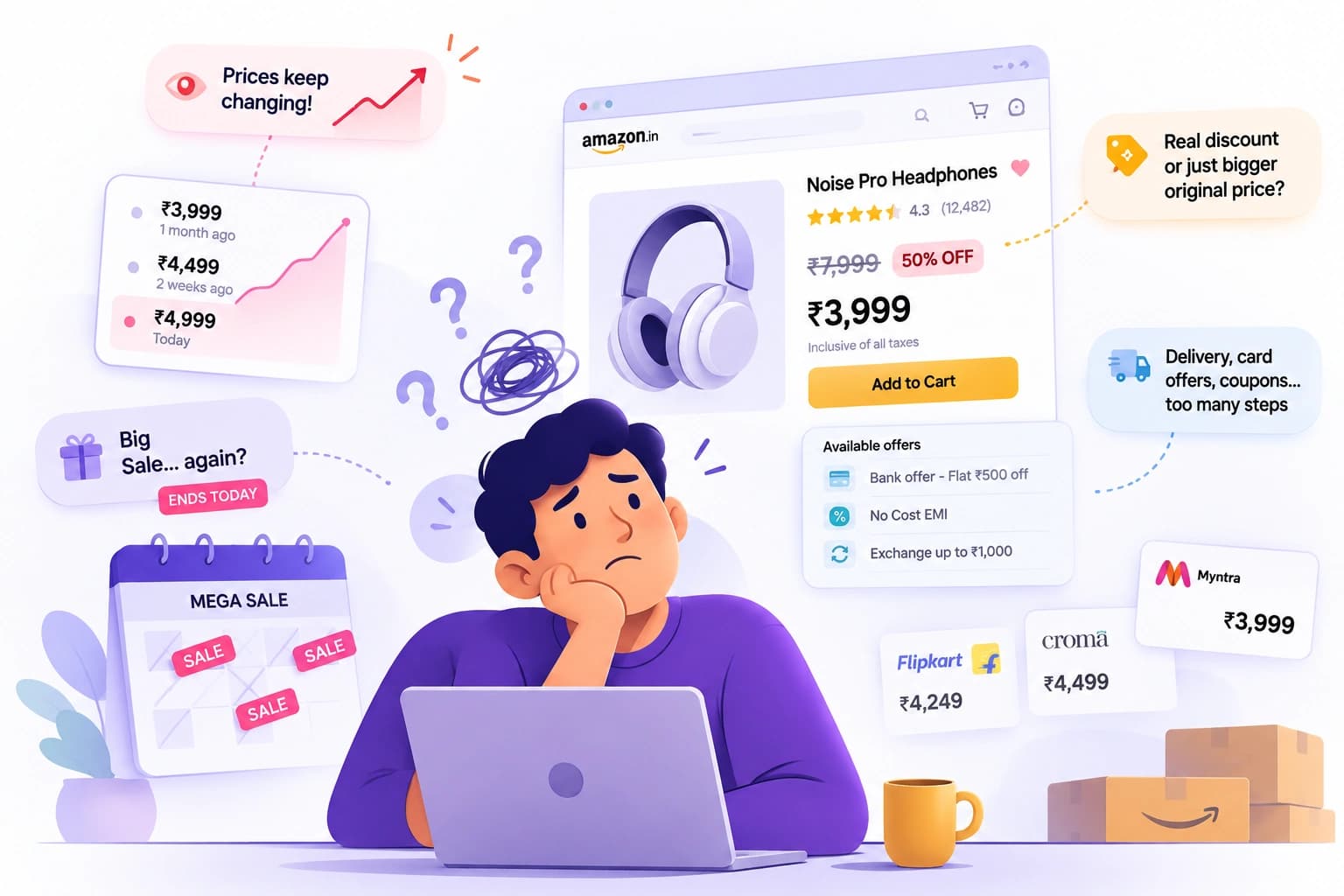
A displayed discount compares today's price with a reference price, usually the MRP printed on the product, or an "original price" shown crossed out. It does not, by itself, tell you how today's price compares with what the product has actually sold for recently. That's the actual test for a fake discount: not whether the percentage looks big, but whether today's price is genuinely lower than a real, recent price, not just a printed one.
This shows up most during big sale events, Amazon's, Flipkart's, or a quick-commerce app's festive sale, when "50% OFF" badges are everywhere and an inflated MRP is easiest to miss. What follows is grounded in India's actual MRP law and a real regulatory enforcement case, not general advice: what MRP means under that law, why price anchoring makes a big percentage feel convincing regardless of the real saving, and what to check on the listing in front of you.
What "50% off" actually means
In India, the Maximum Retail Price printed on most pre-packaged goods is a legal ceiling under the Legal Metrology (Packaged Commodities) Rules, inclusive of all taxes, that a seller cannot exceed. It is not a promise that the product has recently been sold at that price anywhere.
Legal Metrology Rules, 2011That distinction matters because a "50% off" badge is a piece of arithmetic, current price versus MRP, not a claim about how good the deal is. A product can be genuinely 50% cheaper than it was last month, or it can have quietly sold near today's price for weeks while an MRP that was never really charged sits crossed out above it. Both situations can produce the exact same badge. For the arithmetic behind that gap, see the difference between MRP and selling price.
MRP vs. what a product actually sells for
Research on reference-price advertising has found that a crossed-out "original" price shapes how large a discount feels almost independently of the actual saving involved, an effect researchers call price anchoring.
Journal of Business ResearchThe bigger the gap between the crossed-out number and the sale price, the better the deal feels, whether or not the crossed-out number ever reflected a real, recent selling price.
The two scenarios below show why the same badge can mean two different things. Both are illustrative examples, not data from a real listing.
| MRP | ₹7,999 |
| Displayed discount | 50% OFF |
| 30 days ago | ₹4,199 |
| 14 days ago | ₹4,499 |
| Today | ₹3,999 |
Here, today's ₹3,999 is genuinely the lowest price this product has shown in over a month. The discount badge and the recent price history agree.
| MRP | ₹7,999 (rarely, if ever, charged) |
| Displayed discount | 50% OFF |
| 30 days ago | ₹3,899 |
| 14 days ago | ₹3,999 |
| Today | ₹3,999, shown as 50% off ₹7,999 |
Here, today's price hasn't moved in two weeks. The "50% off" badge is arithmetically correct against the printed MRP, and tells you almost nothing about whether now is a good time to buy.
Why this happens
Reference-price anchoring is well documented, but that doesn't mean every inflated MRP on every listing is a deliberate manipulation, and it's worth being precise about what's actually established versus what's merely possible. Manufacturers set MRPs in advance, sometimes years before a product's street price settles; sellers then apply discounts against that printed number, which can produce a large "off" badge without anyone recalculating whether it reflects current reality. A different question is whether a price was moved up just before a sale; our guide on whether the price was raised before the sale covers that check separately.
Regulators do act on how prices are displayed. In September 2025, India's Central Consumer Protection Authority fined an e-commerce company ₹2 lakh because prices were shown as inclusive of all taxes while GST was added on the discounted price at checkout.
CCPA enforcement, Sep 2025That case was about taxes added late, not about reference prices, so it does not tell you whether a given crossed-out price is fair. Separately, the CCPA's Guidelines for Prevention and Regulation of Dark Patterns, 2023 list 13 specified dark patterns, with drip pricing, disguised advertisement, bait and switch and false urgency named as examples.
PIB, 8 Dec 2023Checklist for sale events: seven checks that work in any festive sale
Sales add urgency: countdown timers, "only 2 left", limited-time banners. Urgency does not change the arithmetic. These seven checks work the same in the Great Indian Festival, Big Billion Days, Diwali sales or any other sale, and need no extension or account.
- Find the reference. Note what the percentage is measured against: the printed MRP, a crossed-out "original" price, or a "was" price.
- Look at recent prices. Use the shop's own price history if it shows one. Amazon says its Rufus assistant offers a price history view covering anywhere from one month to a year; Business Today reported on 14 November 2025 that Amazon India's app shows a 30- or 90-day graph. We have not checked either in the app ourselves. Otherwise use your own screenshots from the week before, or an independent history site. Our guide to checking price history on Amazon, Flipkart and Myntra compares the options.
- Recompute the discount. (recent price - today's price) / recent price x 100, as worked through in the difference between MRP and selling price.
- Match the exact product. Same model, colour, size and bundle. A different variant has a different price history, and a price comparison across Amazon, Flipkart and Myntra only works when the listings are the same item.
- Read the offer terms. A price that needs a specific bank card, coupon or exchange is not the price everyone pays. The real price of a product after offers shows how to work out what you actually pay.
- Check who the price is for. Sales often open early for members. Flipkart's Big Billion Days page describes early access for eligible Flipkart Plus members, VIP members and Flipkart credit card holders, and Amazon says Prime members get extra savings. A price shown to a member, or one that needs a particular card, is not the price everyone pays, so note whether you qualify before you compare.
- Treat time-limited deal labels as a timer, not a verdict. Flipkart's sale page describes Price Crash as resetting selected items to "Day 0 prices for 1 hour". A label tells you how long a price lasts, not how it compares with last month. Compare it with recent prices like any other badge.
Sale dates differ by shop and year, so check the shop's own announcement; we do not publish start or end dates here. Two habits help: save the price of items you want in the week before a sale (a screenshot is enough, and you can track prices on an Amazon wishlist if you prefer), and decide your target price before you open the app. Comparing tools that can help with step 2? Read How to choose a price tracker in India.
Packaged goods: compare the price per unit, not the badge
For groceries, skincare and other packaged goods, a bigger discount badge can sit on a worse deal, because packs come in different sizes. Divide the price you pay by the quantity, per 100 ml or per kg, and compare that figure.
A Press Information Bureau release of 8 November 2021 said that a new provision had been introduced to indicate the unit sale price on pre-packed commodities, which "will allow easier comparison of the prices of the commodities at the time of purchase". It said the amendments would come into effect from 1 April 2022. We have not checked how any particular listing displays it, so do the division yourself when the listing does not.
PIB, 8 Nov 2021| Measure | Small pack | Big sale pack |
|---|---|---|
| Size | 100 ml | 250 ml |
| MRP | ₹349 | ₹1,799 |
| Displayed discount | None | 45% OFF |
| You pay | ₹349 | ₹989 |
| Price per 100 ml | ₹349 | ₹395.60 |
The big pack looks like the better deal because of the 45% badge, but ₹989 for 250 ml is ₹395.60 per 100 ml, against ₹349 for the small pack. If you will use the whole big pack, it may still suit you; the point is to compare like with like before the badge decides for you.
How HAULS approaches this
HAULS is designed around one rule: a price counts as low only relative to prices HAULS has itself observed, never relative to a printed MRP. HAULS is pre-launch, so it is not watching prices for you yet. Price History and Honest Discounts describe how it is meant to work, and the methodology page shows the reasoning.
The same check applies to anything inside a shopping haul, a discount badge in a Myntra haul or Amazon haul is measured against the same reference-price question as any other listing.
HAULS is pre-launch
Nothing here shows live data yet. If you want these checks on the product page, join the waitlist and we'll email you when the extension is ready.
How this page was checked
Last checked: 8 October 2026. The MRP statement comes from the Legal Metrology Rules and the unit-price statement from the PIB release of 8 November 2021. The dark-patterns statement comes from the PIB release of 8 December 2023; the Trilegal PDF listed in our sources is a law firm's copy, not the CCPA's own page. The Amazon price-history, Flipkart early-access and Price Crash statements are quoted from those companies' own pages, but we did not test any of these features in the apps. We did not verify any live deal, and the price tables are illustrative with checked arithmetic. If anything here is out of date or wrong, tell us through the about page and we will correct it.
Questions
Is this discount real?
Not necessarily. A percentage badge only compares today's price with the seller's reference price, usually MRP. Compare today's price with what the same product cost over the last few weeks. If the real recent drop is much smaller than the badge, the discount is mostly cosmetic.
How can I spot fake discounts on Amazon?
Check what the percentage is measured against, then compare today's price with the product's recent prices: Amazon's app price history where you have it, your own screenshots, or an independent history site. A big badge on a price that has not moved in weeks is a warning sign.
Is 50% off the same as 50% cheaper?
No. It is 50% below whichever reference price the seller shows, usually the MRP or a crossed-out was price. Your real saving is measured against what the product recently sold for, which can be much smaller than the badge suggests.
Is a Big Billion Days or Great Indian Festival discount real?
The sale name does not decide it. Apply the same checks to any listing in any festive sale: the reference price, recent prices, the exact variant and the offer terms. We have not audited any live deal and do not name sellers or dates.
Does a label like Price Crash mean it is the lowest price?
No. Flipkart describes Price Crash as resetting selected items to Day 0 prices for 1 hour, so it is a time-limited price, not a verdict. Compare it with the item's recent prices, and check the exact variant, before you decide it is a bargain.
Is a bigger pack with a bigger discount cheaper?
Not always. Divide the price you pay by the quantity, per 100 ml or per kg, and compare that figure. A larger discount badge can sit on a worse price per unit. India's packaged-goods rules introduced a unit sale price on pre-packed goods to make this comparison easier.
Is a bank-offer price the real sale price?
Only if you hold that card and meet the offer terms. Note the price without the offer first, then treat the card or coupon discount as a separate, conditional saving. A price that needs a particular card is not the price everyone pays.
Which Indian price tracker shows whether a discount is genuinely real?
No tool can certify a discount. A tracker with price history lets you compare today's price with what the product cost in recent weeks, which is how you judge whether a percentage badge is fair. Coverage and history length differ by tool, so see our price tracker comparison before you pick one.
Does HAULS check whether a discount is real?
Not yet. HAULS is pre-launch, so it is not watching prices for you. It is being built to compare a price with prices it has itself observed. Until then, the seven checks on this page need no tool. Join the waitlist to hear when it ships.
Sources & further reading
Keep reading
 Sale ChecksWas the Price Raised Before the Sale? How to CheckA '40% off' badge can sit on a price raised days earlier. How a pre-sale price rise inflates a discount, and a 6-step manual check, with a worked ₹ example.
 Price TrackingHow to Check Price History on Amazon, Flipkart and MyntraHow to check price history on Amazon, Flipkart and Myntra: the Amazon app graph, Chrome and Google tracking, and a manual method where none exists.
 Price TrackingBest Price Trackers in India (2026): Keepa, BuyHatke, Flipshope and More ComparedWhich price trackers cover Amazon, Flipkart and Myntra, which are free, and what to compare. Each tool's claims read from its own site on 16 Oct 2026.